On the surface, this show is a half-hour comedy that follows the exploits of four Indigenous teenagers in rural Oklahoma who steal, rob and save in order to get to the exotic, mysterious and faraway land of California. From Co-Creators and Executive Producers Sterlin Harjo and Taika Waititi, the show is a great snapshot of rez life in Oklahoma, it has so much heart, and if it was nothing more than that I would recommend it without question. It’s great television.
The last two episodes have felt different, looking at each one of the kids and teaming them up with one of the adults in the show. It explores grief, and why we make the choices we make in life, and it resonates with me in a way I didn’t expect. It also has been touching on native legends like the Deer Lady and the Tall Man…and that’s what I wanted to dive into today.
In an interview about the show for Entertainment Weekly, the creators said this:
For those who may be curious about Reservation Dogs, how would you pitch them on checking it out?
WAITITI: There’s a great idea of mixing the supernatural world with our reality. It’s almost like subverting the idea that people have about native culture and about native communities, and they’re like, “Oh, let’s all be okay with ghosts and shape-shifters.” And then going, “Okay, well, if that’s what you think it is then let’s give you that version as well, where people talk about that stuff all that time like it’s absolutely normal.” There’s a heightened version of what people think it’s like in these communities. It’s like whatever you expect it to be, it’s going to go to be that but we’re going to really twist and f— up what your expectations are. You think you know what you want from the show but you don’t know what you want until we give it to you.
HARJO: I think it references what people think of native people in popular culture and makes fun of that, but also shows you a more real version, which Taika and I come from. There is a version where people are shape-shifters and this is what is discussed. It’s not like, “Let’s sit around a fire and I’ll tell you what I know and all of my mystical knowledge.” It’s just like, you’re on the sidewalk and your auntie’s like, “Yeah, that guy right there, he turned himself into a dog, got shot, and then we saw him limping.” It’s so real and matter of fact, and that’s something that we wanted to capture.
At the end of Episode 6, they are at a cemetery with “houses” built upon the graves and it instantly makes me think of all the graves I’ve seen growing up that looked just like them. In the series you have the Creek Reservation in Oklahoma, but those of the tribe came originally from Alabama, Georgia, and Florida. The Cherokee that were forced to Oklahoma came from Tennessee and North Carolina. In discussing their shared legends, we have to recognize that many of them are shared here.
In Episode 5, we are introduced to the legend of the Deer Lady. Keith Woodstock Fagan has a great write up for her:
Deer Woman can trace her origins to many of the eastern Woodlands and Central Plains tribes that came to Oklahoma, although her legend extends even into the Pacific Northwest. In traditional cosmology, she is a type of supernatural being distinct from spirits or Gods. Among the Cherokee these beings are called Nunnehi “the People Who Live Anywhere” or Ani Yunwitsandsdi, literally “Little Men.” Their function is similar to that of European Fairies- in turns both helpful and devious, but usually their ire serves as punishment for the violation of cultural taboos.
There are many variations of her story, describing her as everything from Nunnehi to Witch or normal Human originally. In her more beneficent aspect, she is associated with fertility and love, but when crossed has quite a dark side. While the Jersey Devil delights in mischievous chaos, and the Mothman serves as an omen of tragedy, Deer Woman operates much more directly, literally with a vengeance.
Most commonly she is depicted as the mortal victim of a savage rape, her body being found in the woods next to a sleeping fawn who lay down beside her so that she would not die alone. Since her attackers went unpunished, the Gods (or Nunnehi, or sometimes even the Deer themselves) grant her wish for justice, whereby she is reborn as a half Human/half Deer. In this guise she lured her former tormentors out into the woods, unaware of her true nature. When they noticed too late that she had hooves instead of feet, she trampled them to death. Afterwards she lived on, continuing to punish those who would prey on feminine innocence.
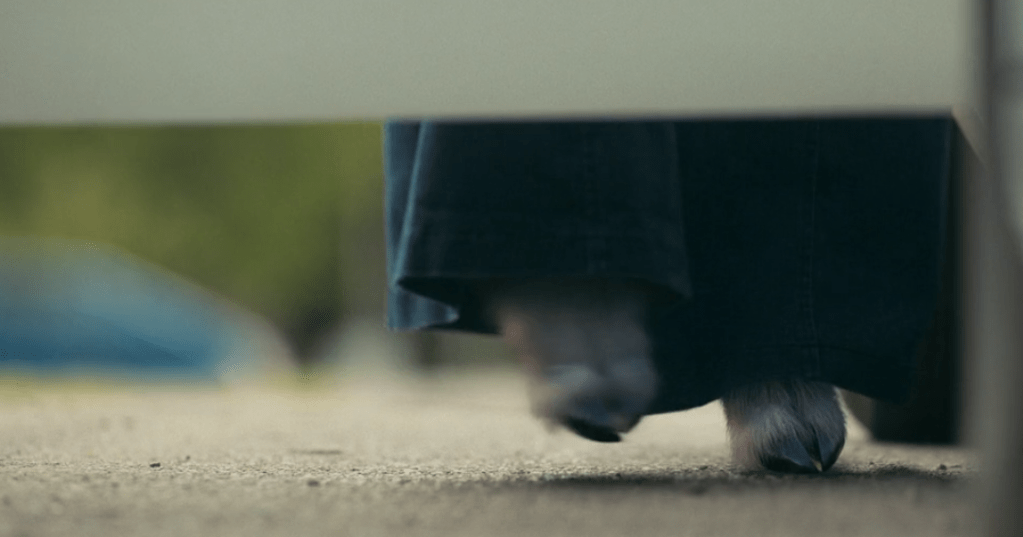
According to Ojibwe tradition, she can be banished through tobacco and chant, but in most tales, the only way to save oneself from Deer Woman is to look at her feet, see her hooves, and recognize her for what she is (before she gets you alone). The legend is meant to show that attraction does not a proper pairing make, and that men ignore or usurp the power of women at their own peril. To recognize the truth the story conceals is to save oneself from misfortune. To ignore the moral is to proceed inexorably into the death dance with Deer Woman.
On the show, the Rez police officer (Light Horseman), Big sees her multiple times during his life. But as she says to him “You are one of the good ones” he never has to fear her.
In Episode 6, we see the father of one of the characters putting out deer corn before hunting season. He sees a dark hairy figure with red glowing eyes. He doesn’t fear the being, he speaks to it. Later in the episode he likens it to Tall Man, which has interesting parallels to other legends.
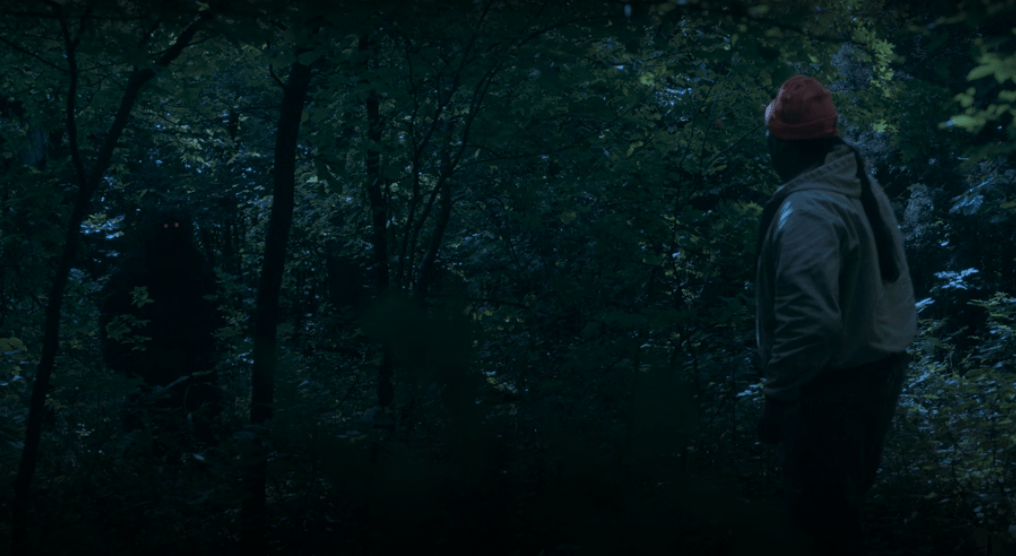
There are many stories of Tall Man, who is also known as Big Man, Big Man-Eater, and Walking Sam, who, like Slenderman (which most likely was influenced by the Lakota legend), has appeared more and more in stories, targeting children.
Silverfox57 of Brick Mythology had a great write up about the differences in the legends, and perhaps some “lumping in” with the nature guardian spirits and the darker spirits that are causing harm. He writes:
At first glance, yes some could approach the story of the Tall Man Spirit as some sort of spooky campfire story told in the same vein as that of Bigfoot and other Urban Legends. It could explain too one name of “Stovepipe Hat Bigfoot” that I came across. That is a disservice to this entity and what it is. Unless you want to try diminishing it’s power by making light of it, to be less scary or intimidating.
It is very likely people have confused two different entities together based on possible mistranslations from the Sioux languages into English. In the Lakota or Western Sioux language, they call Big Foot by the name “chive-tanka” meaning Big or Great Elder Brother. In English, the term gets translated to be “the Big Man.” It’s easy to see why Big Foot hunters and enthusiasts would glom onto a potential mistranslation to embrace it.
On the Oglala reservation, sightings of Big Foot or Big Man are seen as ill omens and warnings of potential tragedies. Where there seems to be sightings and claims of more than one creature or entity, some have put forward the ideas that this entity is a local forest spirit and protector of the land.
Remembering to keep the two separate, Tall Man is found in older stories of bad spirits or giants that once wandered the Earth. They had become prideful and arrogant to the point that they challenged the thunder and lost to it.
It’s certainly good advice. Even in these mountains, there are dark places and vortexes of depression and death. There are also wild places that are still protected by guardians…for how much longer is up to us.
Reservation Dogs is currently running on FX on Hulu, and has been renewed for a second season. I can’t wait to see what comes next.
 BYRD OF ILL OMEN