There is a movie coming out soon called “Antlers” that was based on the story ‘The Quiet Boy‘ by Nick Antosca. Without going into too many details (You can read it for yourself in the link above), the movie goes full-tilt into the legend of the Wendigo. A misunderstood legend almost to the status of the skinwalker in the paranormal/cryptid community. You’ll see what I mean in the trailer:
In press for the feature film, producer Guillermo del Toro had this to say in an interview for Indiewire:
The central supernatural character in “Antlers” is based on the wendigo, a spirit found in Algonquian folklore. Legends describe humans transforming into wendigos because of their greed or weakness and are considered dangerous because of their thirst for blood and ability to bring about evil. “The wendigo has very, very specific cues you need to follow,” del Toro said. “The antlers, for example, are a must. I said, ‘We have to remember we’re not creating a monster, we’re creating a god.’
I love del Toro. His attention to detail in movies like El Fauno in Pan’s Labyrinth has been masterful. Here though, it seems more of the same from the source writing of Antasca who produced episodes of Hannibal with similar imagery.
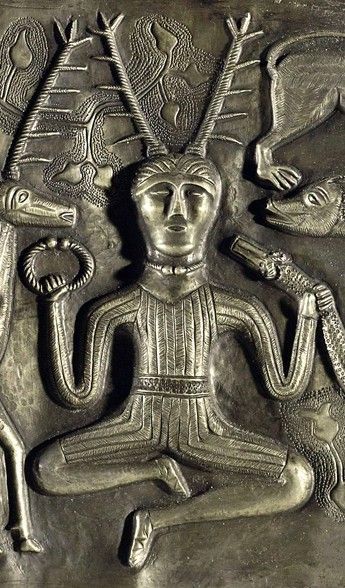
I’d argue the above form is closer to what we see in reliefs of Cernunnos, the horned god. a sacred masculine image that represents the “wild” that del Toro is seeking for the movie monster…and not a comparison I agree with.
What then is a Windigo/Wendigo? To move past the current idea of what it is, we have to look back at the initial legends and descriptions. In fact, without the context of those stories, we only have a “cool-looking movie monster”.
A windigo is a supernatural being belonging to the spiritual traditions of Algonquian-speaking First Nations in North America. Windigos are described as powerful monsters that have a desire to kill and eat their victims. In most legends, humans transform into windigos because of their greed or weakness. Various Indigenous traditions consider windigos dangerous because of their thirst for blood and their ability to infect otherwise healthy people or communities with evil. Windigo legends are essentially cautionary tales about isolation and selfishness, and the importance of community.
Canadian Encyclopida, article by Steve Pitt 2012
I credit Stephen King with the first time I heard of the Wendigo legend in his novel ‘Pet Semetery’. He described the creature as something more akin to the horned creature popular culture has latched onto.
its eyes tilted up like the eyes in a classical Chinese painting, were a rich yellowish gray, sunken, gleaming. The mouth was drawn out in a rictus, the lower lip was turned inside out, revealing teeth stained blackish-brown and worn almost to nubs. But what struck Louis were the ears, which were not ears at all, but curving horns…they were not like devil’s horns; they were ram’s horns.
Lesser known is Algernon Blackwood’s “The Wendigo” story from 1910. It was more famously printed in Famous Fantastic Mysteries in 1944. The illustration made by illustrious artist Matthew Fox clearly shows horns on the creature, which may be the first interpretation that I’ve found, but was most likely influenced by the line in the story:
“But I want ter know,—you!” shrieked the guide. “I want ter see! That ain’t him at all, but some—devil that’s shunted into his place …!
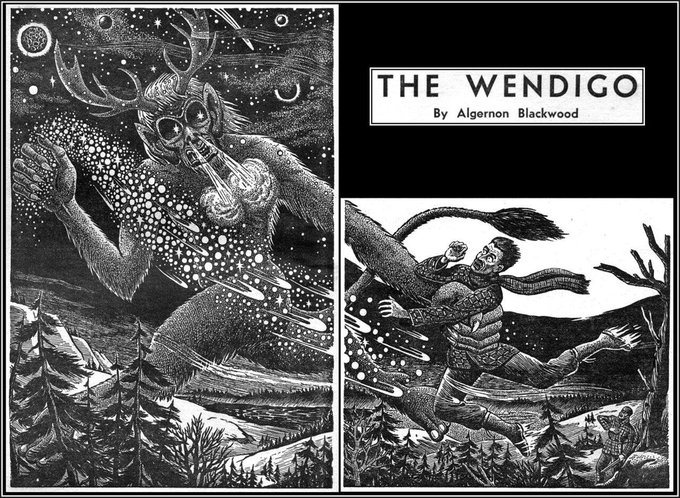
This was perhaps the illustration that inspired so many tellings after, especially fueled by Blackwood’s other writings including Pan’s Garden. Still, it is a far cry from the representation of the original tradition, which was based more on the personification of winter, thoughtless hunger, and selfishness from the needs of the collected tribe. In a way, their cursed nature that appears in most of the legends lends itself more to a werewolf narrative, which is likely why they are a tribe within the World of Darkness series Werewolf: The Apocalypse by White Wolf Studios.

So what do we take away from all this? It’s important to honor the long associated negative attributes of the ice beast and their real-life counterparts like insatiable greed, selfishness, and violence. All too often we are hearing stories of how people are seeing the Wendigo and it is being used as an egregore much like the skinwalker, the goatman, and other popular cryptids. (In its true description, Slenderman owes a lot to the legend). Too many tribes used the creature as a lesson. In the end, Selfish actions and behaviors make our hearts cold, and in certain ways, we all could become Wendigo.
 BYRD OF ILL OMEN
Great article🙂❤️
LikeLike